Monday, January 10, 2011

~ Lava inflating higher than house and advancing ~

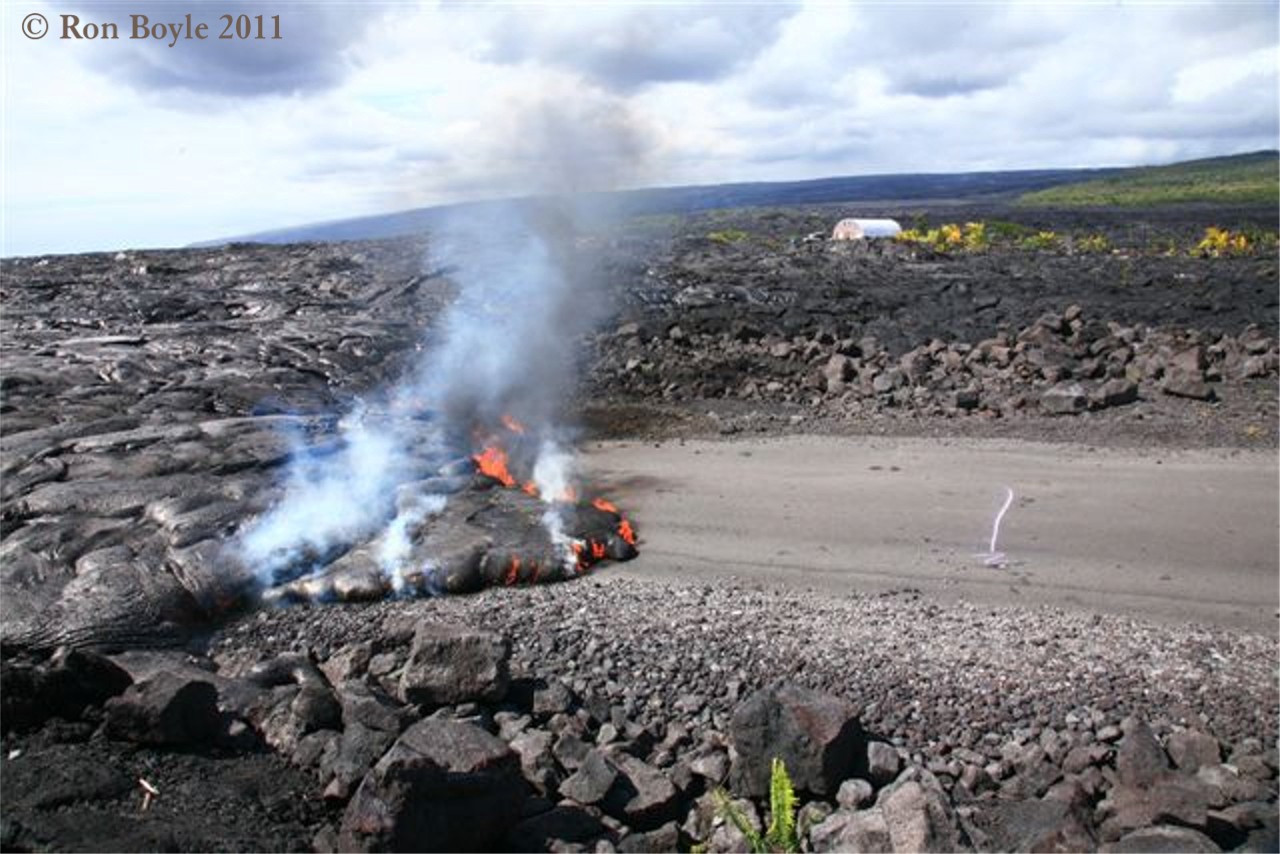
These three photos were taken at dusk last night from the Hawaii County lava viewing area, which is now located directly adjacent to the occupied home being threatened by a continued advancement of lava. The Quonset-styled structure in the distance is the home and you can see molten lava across the area between the people and the home.

I walked the area this morning and noted three large breakouts of lava busting out along a four-hundred foot line of ever inflating lava directly west and south of this residence. These breakouts were very hot and all flowing downhill in the direction of the home, yet remained a few hundred feet away from the home itself. I did not take any photos of this today because the changes were not pronounced enough to be seen.

Further west, for over a quarter mile, many other breakouts were appearing, also springing from a series of mounding lava hills rising by the hour as super-heated rock beneath them forces the crusting surface higher off the ground.This is one of the many breakouts.

Three quarters of a mile southwest of the home and the end of the road there is a long swath of forest and brush burning from another finger of lava moving into that area. A half-mile southwest from there is a feeble ocean entry. Southerly winds are blowing the lava fumes and burning smoke fumes back towards the viewing area. If you are sensitive to fumes you may want to avoid the viewing area tonight.

I will place updates here if the lava moves close to the home.

You can always talk directly with Janguard personnel who are managing the Hawaii County Lava Viewing site. Phone after 2:00 PM up until 9:30 PM seven days a week at 430-1966 or 217-2215. Tom or Steve will give you a pretty good update on the coastal lava flow situation.

Sunday, January 9, 2011

~ Lava continues advancing on home ~

Below, homeowner, in brown, walks with a small group she has just taken on a lava tour of her property. (Click on any image for a larger view size)The most easterly branches of our current lava flow are creeping towards this residents home and access road. The home is technically just outside Kalapana Gardens subdivision, as was Gary’s, but nonetheless is the next threatened home for that community.

This landowner was the second to built atop the 1990 flow back in around 2002, Jean Olson being the first to do so. Gary Sleik was the third to build on the 1990 flow field. Both Gary and Jean lost their homes from molten lava July and November, respectively, last year.

Lava is pooling, filling and inflating within three-hundred feet of the home and in three separate locations.

Above: The lowest section of the advancing lava is only 45-feet away (just out of frame to the right)from severing the homes only access lane that leads to the current terminus of highway 130, which is now also the Hawaii County lava viewing area, as shown below

Many visitors to the end of highway 130 will have noticed the landowners collection of signs and her table of lava artifacts:Peggy told me she makes the signs to get people to slow down and think.

I will be monitoring the site later today and tonight.
EDIT evening of the same day:
Below:
Visitors to the Hawaii County lava viewing site at the current end of Highway 130 gaze out across hot inflating lava as multiple breakouts flow ever closer to the occupied residence we see in the distance: the Quonset type home. The owner was still there at dusk tonight and her access road had not yet been severed y the advancing lava.

Above, one of the many breakouts of pahoehoe within a three to four-hundred feet of the home.

Saturday, January 8, 2011

~ Molten lava approaches home ~ Weak ocean entry ~

Active lava breakouts near the remaining end of Highway 130 are back-filling down towards the nearest occupied structure and were less than three-hundred feet from away at 11:00 AM this morning. If lava continues being fed to the area then it seems likely this home will be claimed by lava within days. Ron took the photo below a couple days ago and the lava on the road is cooling now, but further back towards the house lava remains actively breaking out.

Below: Heat waves waft off the super heated lava that theatens a home

Meanwhile down along the coast over a mile southwest of roads end we have day three of a new ocean entry of lava. This entry is currently quite weak appeared to be stagnating while I was there this morning, but was feebly returning to life an hour later.

I will be keeping a close eye on this flow now and report daily on any changes.

Thursday, January 6, 2011

~ Lava reaches the ocean and covers more pavement ~

Two dominant fronts of surface lava have continued slowly advancing east and southeast across the coastal plain west of and adjacent to Kalapana Gardens homes. As shown in the photo above taken yesterday afternoon by Ron Boyle, lava continued covering more of the end of highway 130 and getting rather close to yet another home. These flows are moving rather slowly at this time and may stall out or stagnate, sparing this home for now.

Above we see people beginning to gather at the present lava viewing location at roads end; witnessing molten rock before them.

Sometime overnight or early this morning the most westerly portion of this December lava flow reached the ocean west of the old Waikupanaha viewing area.

Tuesday, December 28, 2010

~ Coastal plain lava continues filling and spreading ~

(Click image for a large size) At its closest point to a home and to the present barricades that mark the County Viewing Area, molten lava outbreaks are 1200-feet (366 meters) distant toward the west.

West-southwest of the above surface lava is an additional broad area of other surface flows. These flows have now proceeded southeast from the base of the Pulama Pali, east of the quarry, alongside & overtop of the July lava tubes and past the buried location of highway 130 (Old Kaimu-Chain of Craters Road). These two flows are the leading edges of the December Quarry flow. There are also numerous breakouts further up the pali.

My last field report recorded the lava flowing northwest of these locations and about 1400-feet, or 427-meters inland from the present flow front.

USGS/HVO have posted some updated flow field maps that I repost below. The brighter reds are the most recent surface flow locations as of December 22nd; the flow front has advanced further south and southeast since. You can view them on their site and read the full captions here.

Electonic Tiltmeters are showing a little bit of inflation pressures for the first time in weeks:

I am still on vacation but thought I would check out the lava situation on the coast. I’ll check in again in about a week.

Meanwhile, no parking on the hot lava!

Tuesday, December 21, 2010

~ Winter Solstice & total lunar eclipse on full moon ~ Blogger takes a break ~


A full lunar eclipse took place last night in many northern locations (Dec. 20th or 21st depending on time zones). It was too cloudy here (at least at my house) to watch it due to a large and persistent winter rain storm across all the islands. This was a special eclipse: first full one seen on Winter Solstice in the northern hemisphere in 372 years and the next one will be December 21st, 2485.

I am taking some time off from my usual passions of lava and blogging. I will check in from time to time in the next couple of weeks, but will likely not have many lava updates. So, besides the USGS/HVO’s daily eruptive reports, you can always talk directly with Janguard personnel who are managing the Hawaii County Lava Viewing site. Phone after 2:00 PM up until 9:30 PM seven days a week at 430-1966 or 217-2215. Tom or Steve will give you a pretty good update on the coastal lava flow situation.

What an active lava year it was!

I was going to put together a Year-In-Review for the lava flow but realized there were so many remarkable events it made that task become daunting… So… I will suggest that you take some time in the next few days to browse back through these blog posts: try peaking at December 2009 to see what was happing then, Maybe click on each month of 2010 in the Blog Archive found on the far right further down the page. By clicking on a month you can scroll down through some of that months activities, and also select show older posts to quickly scroll down and review an entire months posting at one time; the images themselves often tell the story ;)
Mauna Kea: We have been getting some new snowfalls up on the two monster volcanoes. Mauna Kea Weather Center has a nice selection of cams and they can be viewed in time-lapse day-into-night—Sometimes very cool to watch. I like the Gemini cam view/ here is a sample of one of the time-lapse clips of that cam from December 14th

~~~~ Aloha,
Leigh

~~~~~~~~~~~ The last total lunar eclipse I saw here was August 27th, 2007 at midnight: Here are the images I took of the event:Exact total eclipse and a few stars

CURRENT MOON

Saturday, December 18, 2010

~ From the lava flows perspective ~

In this photo, taken last night at dusk, we are looking towards the southeast from the leading easterly front of advancing surface lava. In the distance we can make out some of the homes in Kalapana Gardens and the Hakuma Horst.(click image for a little bit bigger size. Those more distant homes are just under one mile from the flow front, the closest being approximately 2800-feet away(Peggy's qunset home), and about 3000-feet to the barricades of the Hawaii County lava-viewing site at roads end. The molten lava in the foreground is back-filling a low point of land; flowing northwest.

And the image below shows the same view after dark an hour later. Notice how much higher the lava in the foreground is — that is what we refer to when we mention surface flow inflation (not the other magma chamber inflation); the molten lava beneath the quickly cooling crust thrusts lava higher off the ground in large pillowy shapes.


The flow front we see here is burning through one of the last sizable patches of forest before flooding out onto the flatter portions of the coastal plain, which it has now begun doing.

This lava is not flowing directly toward any of those houses or the end of the road; it is flowing in a filling-sprawling & inflating way- but as of last night, basically in a southerly direction with a southeast bent. Below is the photo I posted yesterday showing the perspective of this lava flow as seen from those homes:(Including the quonset-shaped home I mention above)

I surveyed the lay-of-the-land and tried to guess where this lava may travel to if it continues being feed and progresses – not an easy call this time. That said, I think there is about a 40% chance this flow will reach onto and beyond the end of the road (where barricades are now), threatening the nearest home (Quonset house shown in yesterdays post) within the next ten days, making that a 60% chance it will flow on by and potentially threaten homes on the further end of Kalapana Gardens, near the Hakuma Horst, before reaching the sea.

This surface flow will likely begin sprawling across the lower coastal flats, filling low areas, pooling and inflating higher as it goes. Last July 14th, when the flow front was at this distance from the sea, this same sort of lava action decimated a vast amount of forest and burned one home before reaching the ocean eleven days later. We may see a similar scenario with this December flow; but Pele makes all those decisions around here. This lava seen here in these photos is east of both the July and November flows and tubes and the quarry, but will soon be intersecting them.

One big regulator of these flows is the magma reservoir pressure beneath the Kilauea Volcano. A strong and sustained rise or fall of pressure, as recorded by deformation monitors can greatly affect flow rates: low pressure (deflation) may slow or stall all or portions of the flow front, a rise (inflation) may increase all that activity. Currently the magma pressures are deflating:

There is at least a mile of active surface lava behind this leading edge, running way up the Pulama Pali, with some branches running far east of the other recently flowing lava tubes.

Go with the flow